if confidence level increases what happens to width
Allow's say yous have a sample mean, y'all may wish to know what confidence intervals you tin place on that mean. Colloquially: "I want an interval that I tin be P% sure contains the truthful mean". (On a technical point, note that the interval either contains the true mean or it does non: the meaning of the confidence level is subtly unlike from this colloquialism. More background information tin can exist plant on the NIST site).
The formula for the interval can be expressed as:
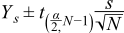
Where, Ydue south is the sample mean, due south is the sample standard deviation, N is the sample size, [blastoff] is the desired significance level and t(α/ii,North-ane) is the upper critical value of the Students-t distribution with N-1 degrees of liberty.
![[Note]](https://www.boost.org/doc/libs/1_41_0/libs/math/doc/sf_and_dist/html/math_toolkit/dist/stat_tut/weg/st_eg/../../../../../../../../../../doc/html/images/note.png) | Note |
|---|---|
| The quantity α is the maximum acceptable chance of falsely rejecting the goose egg-hypothesis. The smaller the value of α the greater the strength of the examination. The confidence level of the examination is defined equally i - α, and often expressed as a percentage. And then for case a significance level of 0.05, is equivalent to a 95% conviction level. Refer to "What are confidence intervals?" in NIST/SEMATECH eastward-Handbook of Statistical Methods. for more information. |
From the formula, it should be clear that:
- The width of the conviction interval decreases as the sample size increases.
- The width increases as the standard deviation increases.
- The width increases as the confidence level increases (0.5 towards 0.99999 - stronger).
- The width increases as the significance level decreases (0.5 towards 0.00000...01 - stronger).
The following instance code is taken from the example plan students_t_single_sample.cpp.
We'll brainstorm by defining a process to calculate intervals for various conviction levels; the procedure volition print these out every bit a table:
#include < boost / math / distributions / students_t . hpp > #include < iostream > #include < iomanip > using namespace boost :: math ; using namespace std ; void confidence_limits_on_mean ( double Sm , double Sd , unsigned Sn ) { using namespace std ; using namespace heave :: math ; cout << "__________________________________\n" "2-Sided Confidence Limits For Hateful\due north" "__________________________________\north\n" ; cout << setprecision ( seven ); cout << setw ( 40 ) << left << "Number of Observations" << "= " << Sn << "\north" ; cout << setw ( twoscore ) << left << "Mean" << "= " << Sm << "\n" ; cout << setw ( 40 ) << left << "Standard Difference" << "= " << Sd << "\n" ;
We'll define a table of significance/risk levels for which we'll compute intervals:
double alpha [] = { 0.five , 0.25 , 0.1 , 0.05 , 0.01 , 0.001 , 0.0001 , 0.00001 };
Note that these are the complements of the confidence/probability levels: 0.5, 0.75, 0.9 .. 0.99999).
Adjacent nosotros'll declare the distribution object we'll demand, annotation that the degrees of freedom parameter is the sample size less one:
students_t dist ( Sn - 1 );
Near of what follows in the program is pretty printing, so let's focus on the calculation of the interval. First nosotros need the t-statistic, computed using the quantile office and our significance level. Note that since the significance levels are the complement of the probability, we take to wrap the arguments in a call to complement(...) :
double T = quantile ( complement ( dist , alpha [ i ] / 2 ));
Note that alpha was divided by two, since nosotros'll be calculating both the upper and lower bounds: had we been interested in a single sided interval then we would take omitted this step.
Now to complete the picture, nosotros'll get the (one-sided) width of the interval from the t-statistic past multiplying by the standard deviation, and dividing by the square root of the sample size:
double w = T * Sd / sqrt ( double ( Sn ));
The 2-sided interval is and so the sample mean plus and minus this width.
And apart from some more pretty-printing that completes the procedure.
Let's take a look at some sample output, showtime using the Estrus flow information from the NIST site. The information set was collected past Bob Zarr of NIST in January, 1990 from a heat catamenia meter scale and stability analysis. The respective dataplot output for this test can be found in department three.5.ii of the NIST/SEMATECH e-Handbook of Statistical Methods..
__________________________________ 2-Sided Conviction Limits For Hateful __________________________________ Number of Observations = 195 Mean = 9.26146 Standard Deviation = 0.02278881 ___________________________________________________________________ Confidence T Interval Lower Upper Value (%) Value Width Limit Limit ___________________________________________________________________ l.000 0.676 1.103e-003 9.26036 9.26256 75.000 ane.154 1.883e-003 9.25958 9.26334 90.000 1.653 two.697e-003 9.25876 9.26416 95.000 1.972 3.219e-003 9.25824 9.26468 99.000 ii.601 4.245e-003 9.25721 ix.26571 99.900 iii.341 5.453e-003 9.25601 9.26691 99.990 3.973 6.484e-003 nine.25498 9.26794 99.999 4.537 7.404e-003 ix.25406 9.26886
As you tin can see the big sample size (195) and small standard deviation (0.023) accept combined to give very small intervals, indeed we tin can be very confident that the truthful mean is 9.2.
For comparing the next case data output is taken from P.Thou.Hou, O. W. Lau & G.C. Wong, Analyst (1983) vol. 108, p 64. and from Statistics for Analytical Chemical science, 3rd ed. (1994), pp 54-55 J. C. Miller and J. N. Miller, Ellis Horwood ISBN 0 13 0309907. The values result from the determination of mercury by cold-vapour atomic absorption.
__________________________________ ii-Sided Confidence Limits For Hateful __________________________________ Number of Observations = iii Hateful = 37.8000000 Standard Deviation = 0.9643650 ___________________________________________________________________ Confidence T Interval Lower Upper Value (%) Value Width Limit Limit ___________________________________________________________________ l.000 0.816 0.455 37.34539 38.25461 75.000 1.604 0.893 36.90717 38.69283 90.000 two.920 1.626 36.17422 39.42578 95.000 iv.303 2.396 35.40438 forty.19562 99.000 9.925 five.526 32.27408 43.32592 99.900 31.599 17.594 20.20639 55.39361 99.990 99.992 55.673 -17.87346 93.47346 99.999 316.225 176.067 -138.26683 213.86683
This time the fact that there are but iii measurements leads to much wider intervals, indeed such big intervals that it's difficult to exist very confident in the location of the hateful.
Source: https://www.boost.org/doc/libs/1_41_0/libs/math/doc/sf_and_dist/html/math_toolkit/dist/stat_tut/weg/st_eg/tut_mean_intervals.html
0 Response to "if confidence level increases what happens to width"
Post a Comment