Thai artisans revive old crafts to weave new fashion and stories for modern market
PHU PHAN, Thailand: Drawing was a matter of secrecy for Tavee Meboot when she was a little girl. The more she drew, the more than money her male parent had to fork out to buy new notebooks.
Her family unit could not afford to keep doing that. So the young Tavee used each notebook sparingly and kept her art hole-and-corner or until she ran out of pages for her childhood imagination.
"I liked drawing but nosotros were poor. Each time I needed a new notebook, my dad would ask 'Why practice you buy it so often?'. The notebook was actually for fine art assignments from schoolhouse," Tavee, now 43, reminisced with a smile.
"I sneakily used it for my own drawings."
Tavee's beloved for art was tucked abroad in her centre. She grew into a farmer in her hometown of Sakon Nakhon, northeastern Thailand. Her life revolves around the seasons on the Phu Phan mountains, her paddy fields, cassava farm and safety plantation.
A few years ago, a motorcycle blow kept her immobile for months. That was when she got to know Bhukram - a clothing make from her pocket-size village of Nang Toeng.
Over the past seven years, Bhukram has revived the disappearing fine art of cotton weaving in the community. Its artisans are local villagers who abound, weave and dye cotton wool past hand. With needles and threads, they and so tell the story of local livelihoods through intricate embroidery that has given Bhukram its unique grapheme.
This is a cosmos of Pilan 'Meaw' Thaisuang, a Thai historian who is passionate almost nature and the traditional way of life on the hills of Phu Phan.
Meaw grew upward in Nang Toeng, where generations of residents have lived a elementary life close to nature. Her childhood was shaped by the richness of the woods, where children played and looked for food with their parents.
"I love this place very much," said Meaw, who had left domicile to pursue a university caste and work in Bangkok, 600 km away, for ten years.
"I always wanted to come up home later finishing my teaching. I wanted to come back to do something and stay with my parents."
Behind her, different kinds of cotton garments fill a new studio. The two-storey wooden building is a place where artisans run into to discuss designs and submit their work for review. The infinite too functions as a shop and is open up to the public every Saturday.

Initially, Meaw worked as a historian in Bangkok with architects and communities. Her love for local fabrics and history, and longing for nature dorsum habitation made her study the past of Nang Toeng hamlet.
She discovered that cotton wool used to exist grown along the farmland and harvested for weaving elementary garments. It was then handspun into yarn and soaked in natural blue dye from the local indigo constitute.
Then Bhukram was built-in. Meaw left her regular task for an uncertain career path in the village. Little by little, she worked with local women to breathe new life into the old artform, infusing it with manus embroidery that depicts their livelihoods and the nature around them.
Colourful flowers and copse, streams, farms and paddy fields make up the designs of Bhukram'due south products. They range from scarves to jackets, dresses and shirts - all made from cotton wool by hand.
Each of them is unique with its ain embroidery blueprint that is just produced one time to reverberate the artisan's perception of the environment. Prices outset from nigh United states of america$45 for a scarf but tin go across US$500 for a apparel.
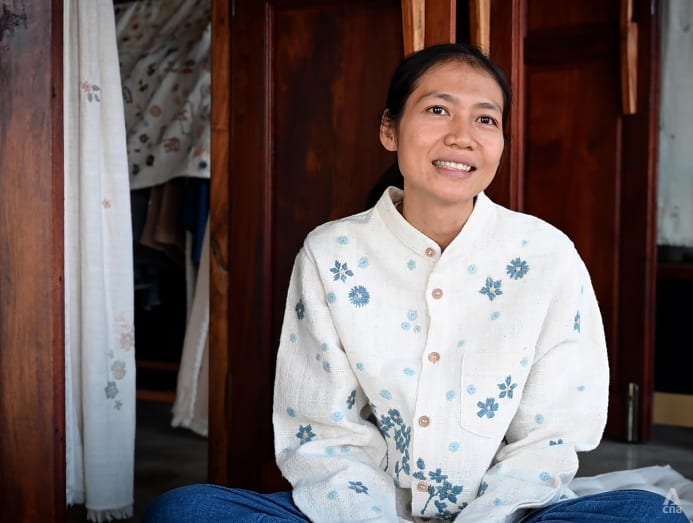
"I'm thankful to Meaw for giving me an opportunity to piece of work like this," said Tavee, who embroiders garments for Bhukram when she is not working on farm chores.
"This is what I wanted to do when I was little."
To her left, an indigo-dyed cotton jacket shows a beautiful scene of a season change, when flowers bloom on Phu Phan and plow its hills into a colourful palette of red, pink and white. Some of them take fallen into a stream, where white storks search for fish amidst groups of rocks.
The embroidery was inspired past a car ride upwardly the Phu Phan mountains, when her eyes were amazed by the vivid display of colours, and her favourite place at the pes of a hill where her grandmother used to take her to look for mushrooms.
"WE DON'T Accept TO WAIT FOR THE MEN"
In the hamlet of Nang Toeng, 45 embroiderers work with Bhukram. They are relatives, neighbours and friends who mainly farm for a living.
Embroidery is usually done when they are free and each piece tin can take weeks or months to complete.
The artisans are paid when they submit their piece of work. The amount varies according to the intricacy and quality of the needlework.
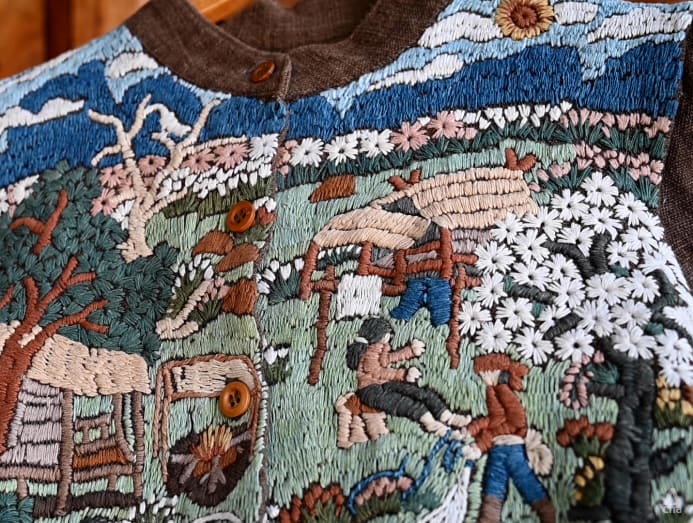
For local women, this is a source of additional income for their families - ane that does non require them to change their way of life.
"The income may not be regular like US$600-900 every calendar month and there is no overtime. But by working from habitation and doing embroidery, I tin sweep the floor, await after my child and my dogs, water my plants, tidy up my house and cook. My work stays with me," Tavee told CNA.
Many people her age had to leave home to find jobs in Bangkok, she said, "but I don't need to do that".
Gradually, extra income from the commercial handicraft production has improved the life of many women in Nang Toeng.
Besides being able to support their families, they also feel a sense of pride and appreciate their financial independence. Existence able to earn as well means more bargaining power in family discussions and for stay-at-dwelling house mothers, the ability to stand on their own feet.
"When my child asks me for money, the money comes from me - his mother," Tavee said.
"We don't have to wait for the men."
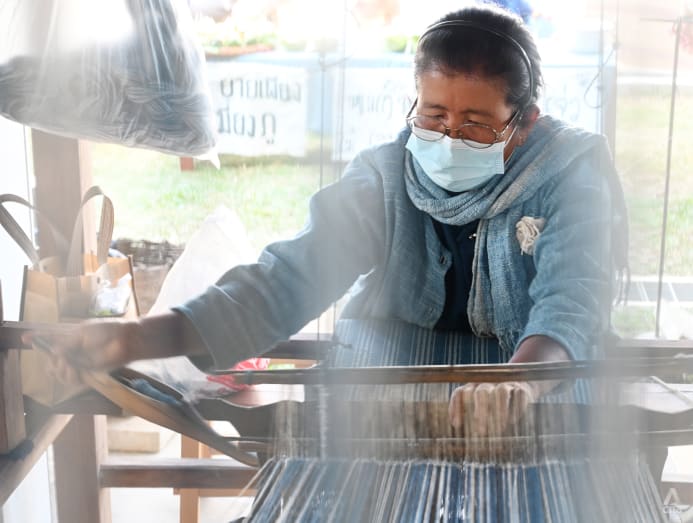
Before the opening of the studio, Bhukram operated most exclusively online through its Facebook folio, which now has more than 33,000 followers.
Each collection contains a limited number of items. They are all unique and come up with proper name tags and photographs of the artisans who created them - weavers, dyers, seamstresses and embroiderers.
A few days before the sale, photos of the garments will be posted online for customers to browse. Most of the products are ordinarily taken within minutes once the sale begins.
Customers who cannot buy in time have to wait for weeks or months before a new collection is launched.
"I'm proud, especially when I receive compliments from customers. I'thousand fifty-fifty more than proud when they want my work," said embroiderer Areena Tabonglek.
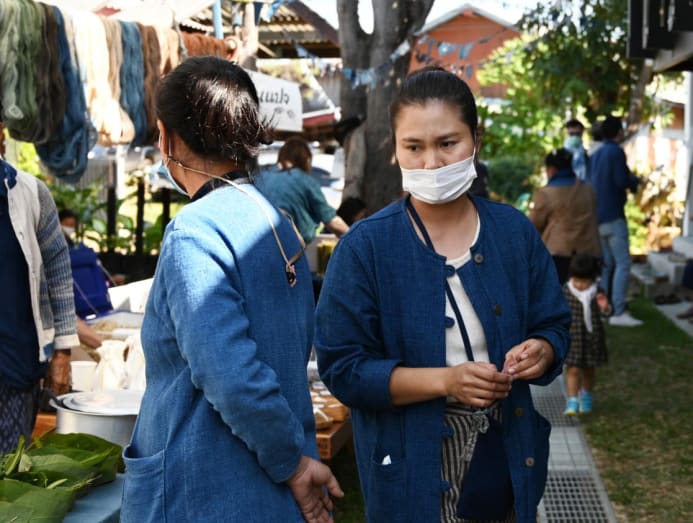
Five years ago, she moved to Nang Toeng to take care of her mother. At that time, she had no job and only basic sewing skills. Just working with Bhukram has changed that.
"Whenever Meaw posts our work online, I'll keep checking information technology. When customers comment 'Oh wow! Information technology's and so beautiful!' or write 'Reserve'," she said with a broad grin, "I'thou proud, so very proud."
"I TRY TO IMITATE NATURE"
Besides operating as a clothing brand, Bhukram likewise tries to communicate with society about preserving nature and the local way of life.
According to Meaw, the make does it through its intricate designs, environmentally-friendly materials from nature and traditional production process that engages people in the community.
"I want people who run across our clothes to recall 'the forest of Phu Phan is so cute and I desire to tell others about it'. I want people in Sakon Nakhon to see how others capeesh it and how our make is trying to talk about information technology," she told CNA.
The message is also for its artisans - the local residents of Phu Phan. Their job requires them to closely notice the natural surround and employ them as inspiration to create work.
For embroiderers like Tavee and Areena, they have to come upward with their own blueprint in one case they are assigned a concept for a piece of clothing. Information technology could be a patently dress, jacket or scarf, which still needs to be decorated.
This is their canvas, where they tell a story of their home with needles and threads, feelings and imagination.
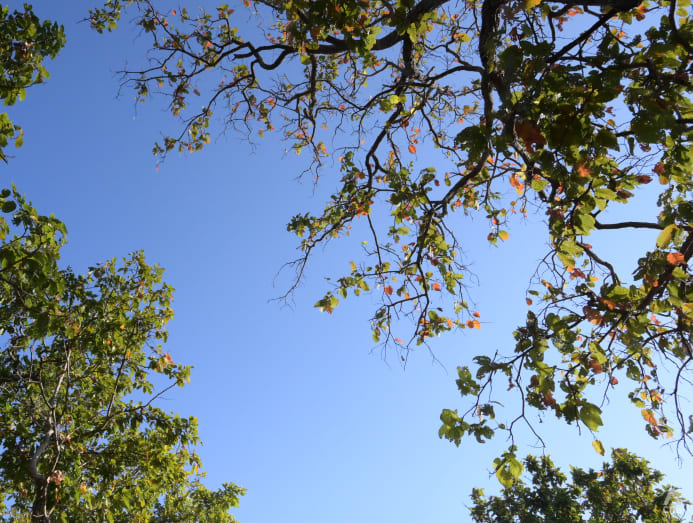
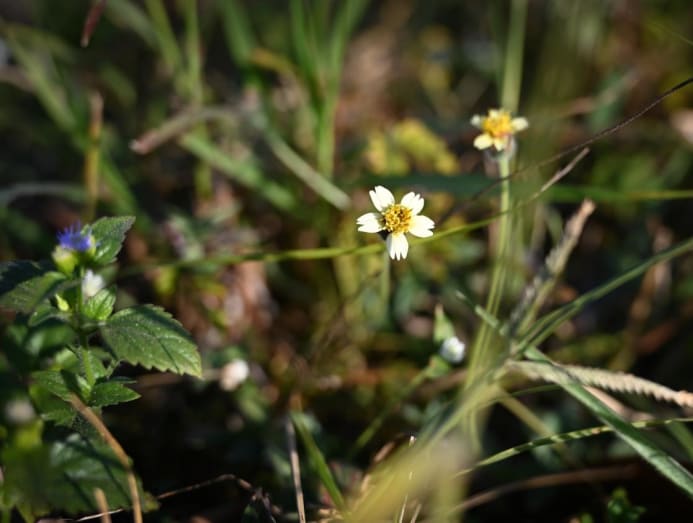
"Whether information technology would be the wood on the hills, the trees or wild daisies, I at present spend more than time looking at them. In the past, if I saw a tree, I'd think information technology could be cut. At present, I've grown to realise information technology's fertility and if possible, I don't want information technology to be cutting," said Areena.
The wild daisy is her favourite flower because she used to make a crown out of them when she was a footling girl.
Her embroidery may non exactly mirror its shape, she added, but she always tries to replicate its fragile petals and leaves, curves and gentleness when she works.
"I endeavor to imitate nature equally much equally I can."
In its early days, Bhukram had nigh 130 embroiderers. But equally the brand grew, the number of its artisans has dropped to 45.
Co-ordinate to Meaw, every stride of the production is time-consuming and requires attention to item. Not only that, she added, the artisans also need to enjoy translating ideas into designs and keep improving their work.
"So, we only have perfectionists who stayed considering they really love it," she said.
GO SLOW
In Thailand, Bhukram is popular among people who value nature-friendly handicrafts, equally opposed to fast fashion.
Fast fashion refers to the mass product of inexpensive, trendy garments that are low-quality and disposable. The business model is mutual in Thailand and frequently employs low-paid workers.
Each year, various practices in the way industry have devastating impacts on the environment.
According to the Un, the equivalent of one garbage truck of textiles is landfilled or burned every 2nd and if nothing changes, "by 2050 the mode industry will utilize up a quarter of the globe's carbon budget".
"Speed destroys many things," Maew said. "Slowness, on the other hand, destroys the environment less."
For 7 years, Bhukram's time-consuming production, limited merchandise and unique designs have continued to attract customers from across the land. Many of them flew or drove for hours to attend the opening of its studio in Nang Toeng hamlet.
"I'grand amazed by their embroidery, which requires a lot of attention and care. Their work isn't produced en masse like other brands," said Nitaya Onhan.
She took a flight from Bangkok to Sakon Nakhon with her friends and drove for an hour to the hamlet then that she could meet the artisans and buy their work.
"There is plenty of apparel with embroidery only for many brands, it doesn't tell a story," said another customer, Chalunthorn Boonwattanaphon.
"What I really like almost Bhukram is their stories, which often have animals like buffaloes and paddy fields. It's like I was transported there and got to share the experience with the embroiderer."
The new studio in Nang Toeng is full of people.
A hum of conversation can be heard on the ground flooring, where customers assemble around rows and shelves of garments.
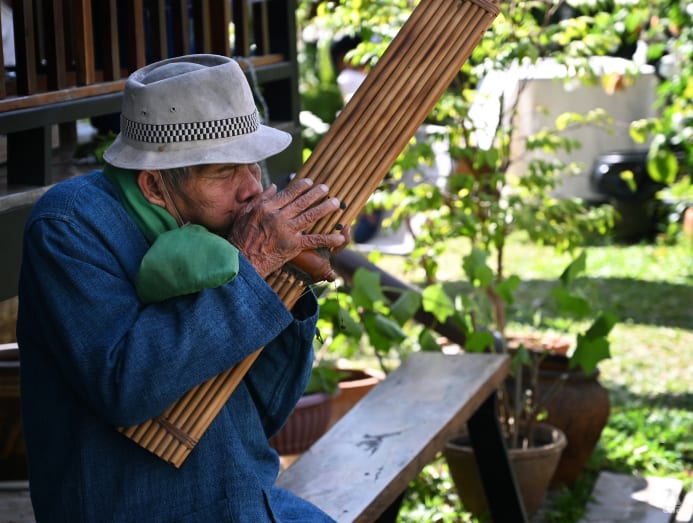
Outside, a man in an indigo jacket fills the air with his music from a bamboo mouth organ. Above him, a curtain of raw cotton on white strings flutters in the breeze.
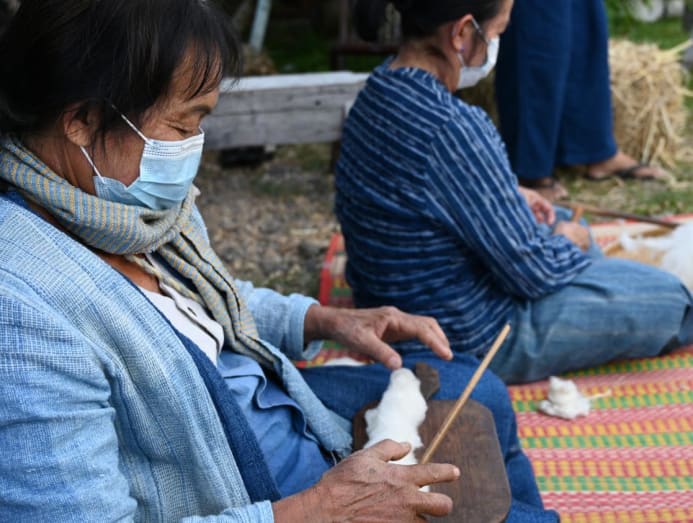
A group of local women sit in a circle on the grass. Their wrinkled easily move with precision as they work with cotton from the fields, turning information technology into fine threads.
One day, these thin fibres will plough into clothes and echo the story of nature and the pocket-sized village where they grew.
Source: https://cnalifestyle.channelnewsasia.com/asia/thailand-bhukram-sakon-nakhon-artisan-embroidery-294836
0 Response to "Thai artisans revive old crafts to weave new fashion and stories for modern market"
Post a Comment